 Clouisle
User Memories
Let Agents retain continuity and personalization in long-term interactions through entities, relationships, and memory retrieval.
Feature Overview
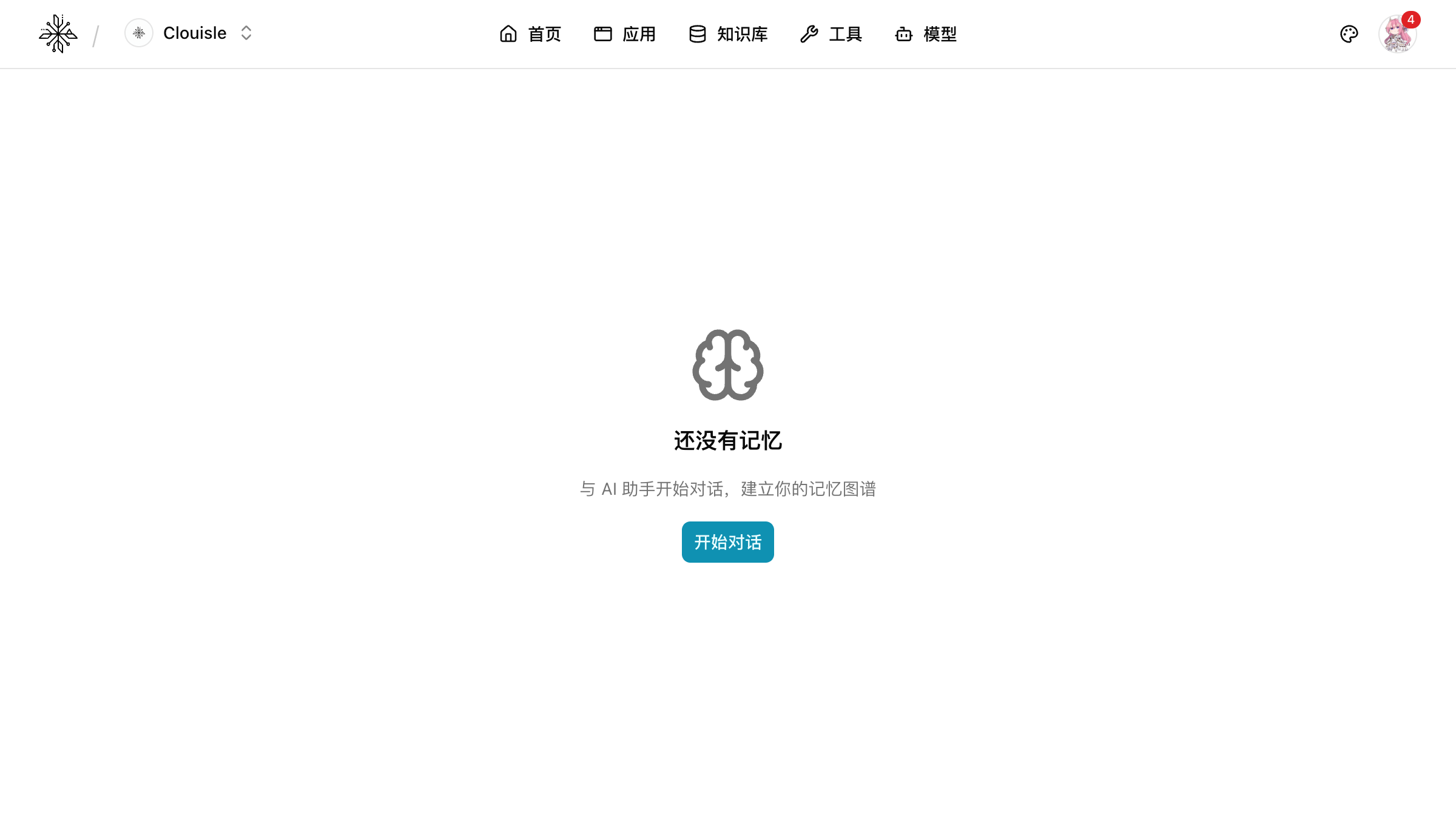
User memories are used to save key information accumulated from users during long-term interactions. Their goal is not to record every sentence of a conversation, but to extract facts, preferences, and relationships worth reusing long term.
Use Cases
Suitable for:
- Long-term companion assistants
- Customer management and service applications
- Scenarios that need to continuously understand user preferences, project background, or historical goals
Prerequisites
Before enabling this feature, we recommend confirming:
- The application truly needs long-term continuous interaction
- It is clear what information is worth remembering
- The team already has basic principles for memory scope and privacy boundaries
Steps
Step 1: Define the memory scope first
We recommend prioritizing:
- User preferences
- Ongoing projects
- Long-term goals
- Important identity and relationship information
We do not recommend writing all temporary chat content into memory.
Step 2: Understand entities and relationships
Memories can usually be split into two categories:
- Entities: people, projects, preferences, skills, goals
- Relationships: what someone likes, what someone is working on, who something is related to
Step 3: Enable automatic extraction or a manual review strategy
If the platform supports automatic extraction, focus on considering:
- Extraction granularity
- Whether manual correction is allowed
- Whether source tracing is retained
Step 4: Verify that memories are actually used
After enabling the feature, validate through multi-turn questions:
- Whether later answers correctly reference known preferences
- Whether memories help reduce repeated questions
- Whether incorrect memories can be discovered and corrected
Result Validation
When the memory feature is effective, you can usually see:
- More stable answers across continuous conversations
- More consistent understanding of user background
- Memory entries have sources, are traceable, and can be adjusted
Value
The core value of user memories is to make an Agent shift from "every time feels like the first meeting" to "knowing the user's background and providing continuous service".
Notes
- Do not record low-value memories just to pursue quantity
- Incorrect memories are more dangerous than no memories. A correction mechanism must be retained
- When sensitive information is involved, privacy and governance boundaries should be clarified in advance
Notification Channel Configuration
Establish stable notification outlets in the order of selecting a channel, filling in parameters, testing sending, and launching governance.
System Administration
Establish a platform management system in the order of dashboard inspection, organization governance, site rule configuration, and audit closed loop.